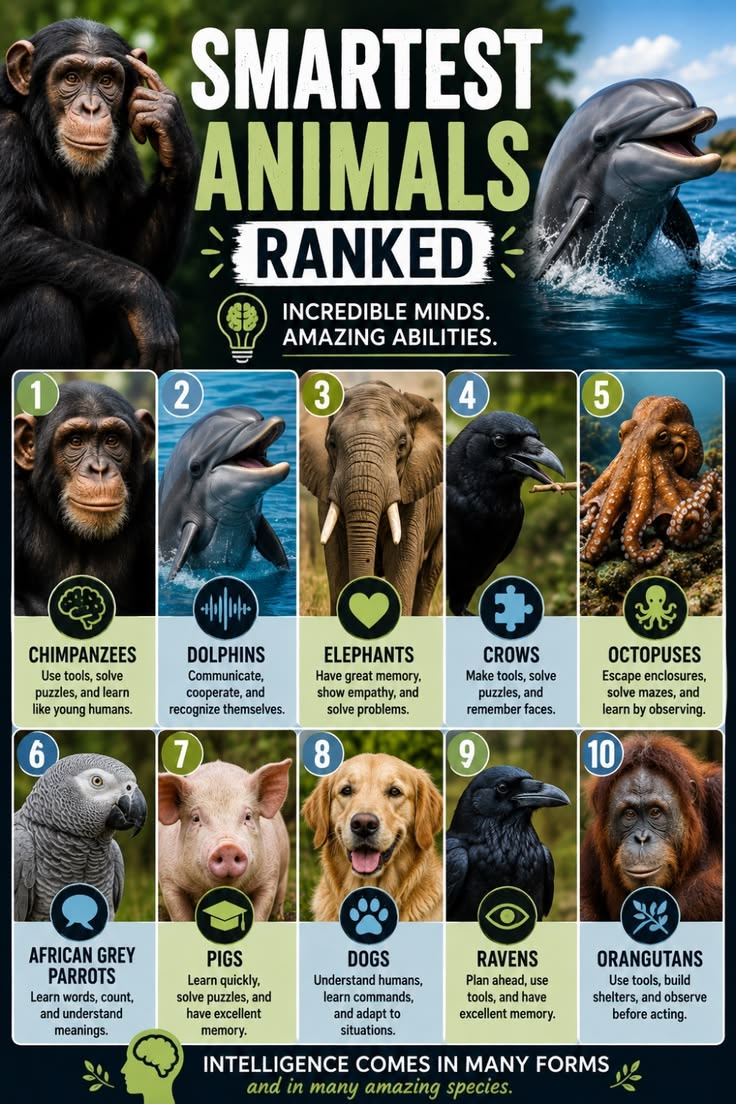
Animal intelligence has long fascinated scientists and the public alike. Rather than a single ranking that applies across every skill, research shows that different species excel in distinct cognitive domains such as tool use, social learning, self-recognition, memory and problem-solving. Evidence from controlled studies and long-term field observations consistently highlights several groups as particularly advanced. Great apes, dolphins, elephants, corvids, parrots and octopuses stand out for their remarkable abilities, revealing that sophisticated cognition has evolved along multiple evolutionary paths.
Great Apes: Closest Cognitive Relatives
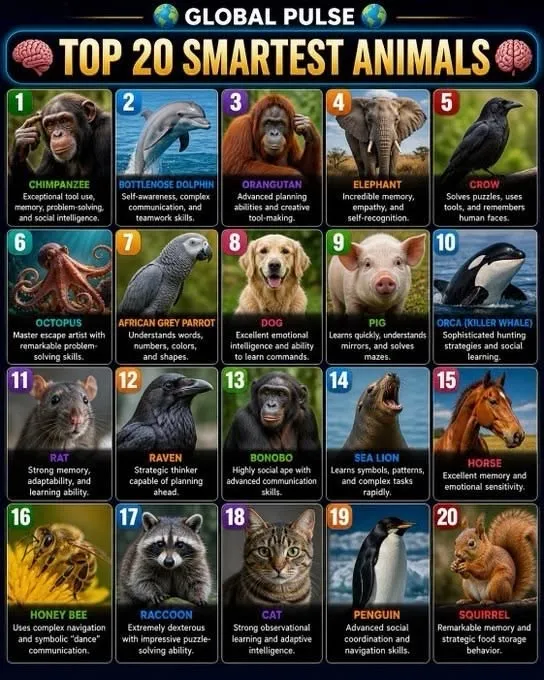
Chimpanzees, bonobos and orangutans frequently top lists of non-human intelligence because of their combination of tool manufacture, social complexity and self-awareness. Chimpanzees were the first non-human animals shown to pass the mirror self-recognition test in 1970, when individuals used reflections to examine marks on their own bodies. In the wild, chimpanzees fashion tools for specific purposes: they strip leaves from twigs to fish for termites, use stone hammers and anvils to crack nuts, and in some populations sharpen sticks into spears for hunting. These behaviours vary between communities and are transmitted socially, forming distinct cultural traditions.
Bonobos demonstrate strong social cognition and have participated in symbol-based communication studies. Orangutans show forward planning, preparing tools hours before they are needed. Across the great apes, the capacity for insight, cooperation and cultural transmission places them near the top of comparative cognition research.
Dolphins: Masters of Social and Communicative Intelligence
Bottlenose dolphins exhibit advanced social structures and communication. They pass the mirror self-recognition test and use signature whistles that function similarly to names, allowing individuals to address one another. Some populations carry marine sponges on their snouts as protective tools while foraging on the seafloor, a behaviour passed from mothers to daughters and recognised as a cultural tradition.
Dolphins also display sophisticated cooperative hunting strategies that differ by region. Their large brains and complex social lives support rapid learning, imitation and long-term memory of individuals and calls. These traits underscore a form of intelligence heavily oriented toward social coordination and communication.
Elephants: Memory, Empathy and Cooperation
Elephants possess exceptional long-term spatial memory, enabling matriarchs to recall distant water sources across decades and guide herds through droughts. They have passed the mirror self-recognition test and demonstrate cooperative problem-solving: in experiments, individuals wait for a partner before pulling a rope that delivers a shared reward. Observations of elephants investigating bones of deceased companions and assisting injured or distressed herd members suggest emotional depth and empathy.
Although their cerebral cortex contains fewer neurons than a human’s, the absolute size of the elephant brain and the density of neurons in certain regions support complex social knowledge and behavioural flexibility. Their intelligence appears particularly strong in memory, social awareness and cooperative tasks.
Corvids and Parrots: Avian Cognitive Specialists
Among birds, crows, ravens and certain parrots rival or exceed many mammals in specific skills. New Caledonian crows manufacture hooked tools from twigs and leaves in the wild and, in laboratory settings, spontaneously bend wire into hooks to retrieve food. They can use one tool to obtain another and solve multi-step puzzles that require planning and causal understanding. Ravens demonstrate similar foresight and social cunning.
African grey parrots have shown impressive symbolic abilities. The famous parrot Alex learned labels for objects, colours, shapes and quantities, demonstrating comprehension rather than mere mimicry. Other parrot species use tools and display playful problem-solving. These avian achievements are especially striking given that bird brains are organised differently from mammalian brains, illustrating that advanced cognition can arise through distinct neural architectures.
Octopuses: Intelligence on a Separate Evolutionary Path
Octopuses represent the pinnacle of invertebrate intelligence. With more than 500 million neurons, two-thirds of which are located in their arms, they solve mazes, open jars, navigate complex obstacles and use objects as tools or shelter. They learn through observation and can escape enclosures with remarkable ingenuity. Because their intelligence evolved independently of vertebrates, octopuses offer a unique window into how problem-solving and behavioural flexibility can develop in a soft-bodied, short-lived solitary animal.
Broader Insights into Animal Cognition
Other species contribute important pieces to the picture. Pigs demonstrate spatial memory and can learn joystick tasks. Certain dogs have learned more than a thousand object names. Capuchin monkeys maintain stone-tool traditions spanning thousands of years. Even some fish, such as cleaner wrasse, have shown evidence of mirror self-recognition.
These findings collectively challenge the idea of a simple intelligence hierarchy. Instead, cognition appears multidimensional. An animal may excel at tool manufacture while another leads in social memory or communicative complexity. Domestication, ecological pressures and social systems all shape the forms of intelligence that evolve.
Why Animal Intelligence Matters
Studying cognitive abilities in other species deepens understanding of how intelligence itself arises. It also informs conservation efforts, welfare standards and ethical considerations. Recognising that chimpanzees maintain cultural tool traditions, that dolphins use signature calls, that elephants remember individuals across decades, and that crows craft tools reveals a richer natural world than one measured solely by human standards.
The smartest animals remind us that remarkable mental capacities exist across the tree of life. From the forests of Africa and Asia to the oceans and even the intertidal zone, intelligence takes many forms—each adapted to the challenges and opportunities of a particular way of living.
Read more – wishdua.com
